
The question comes up in almost every conversation. A teacher is interested. They have done the salary math. They understand the cost of living numbers. And then someone — a parent, a partner, a colleague — asks the question that stops the whole conversation: "But is it safe?"
The hesitation is understandable. Vietnam is far away. Most people's mental image of Southeast Asia comes from news headlines that skew toward chaos. And moving to another country is a big decision, so caution feels appropriate.
The problem is that caution built on bad information is not really caution. It is just fear. The data on Vietnam's safety is publicly available, it is specific, and for most teachers reading this, it tells a story that is the opposite of what they expected.
What the Crime Index Actually Shows
Numbeo is the world's largest database of user-contributed data on cost of living, quality of life, and crime. Their Global Crime Index scores countries on a scale from 0 to 100 — the higher the number, the more crime. The index draws from tens of thousands of responses from residents and expats who live in these places.
A teacher from São Paulo or Medellín asking whether Vietnam is safe is, statistically speaking, asking whether a safer place is safe enough. The answer is almost always yes.
For the first time in years, I can walk at night without fear.
What Violence Against Foreigners Actually Looks Like
Violent crime against foreigners in Vietnam is extremely rare. This is not a tourism board talking point — it is backed by the experience of the expat community that has been living and working in the country for decades. Foreign teachers, business owners, retirees, and long-term residents consistently report that physical safety is simply not a daily concern.
Ho Chi Minh City has roughly nine million people. Hanoi has around eight million. These are enormous, dense cities. But the category of danger is different from what teachers coming from Latin America or parts of Africa are accustomed to. There is no neighborhood where foreign teachers are targeted for robbery at gunpoint. There are no gang territories to navigate around.
The most common safety issue foreigners encounter in Vietnam is petty theft, specifically bag snatching on motorbikes in tourist-heavy areas. It happens, and it is worth knowing about. The solution is simple: do not carry a bag open on your shoulder in busy tourist strips. That is a manageable inconvenience, not a threat to personal safety.
I leave my phone on the cafe table and go to the bathroom — nobody touches it.
The Traffic Question
If there is one genuine safety topic for new arrivals in Vietnam, it is motorbike traffic. HCMC has millions of motorbikes on the road at any given time. The flow is dense, fast, and follows rules that are invisible to outsiders. Crossing the street for the first time feels genuinely alarming.
Most teachers adapt within two to three weeks. The traffic looks chaotic but has its own internal logic — it flows around pedestrians rather than through them. The key is to move slowly and predictably. Drivers adjust.
For teachers who do not want to navigate traffic on foot or a motorbike, Grab solves the problem completely. Grab is Southeast Asia's dominant ride-hailing app — equivalent to Uber. A Grab ride across the city costs a few dollars. Many teachers use Grab exclusively at night and never find themselves in an uncomfortable situation.
What Camila Did on Her First Weekend
Camila is a teacher who joined through UP2U in 2025. Her family spent the weeks before her departure sending her article links — generic travel warnings, embassy advisories, worst-case scenarios. She arrived nervous.
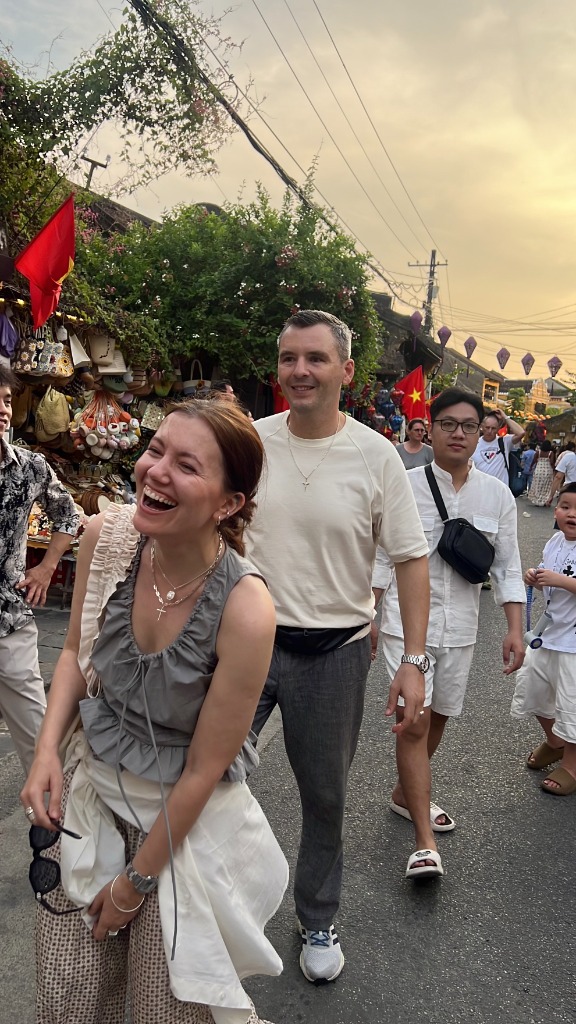
Her first weekend, she walked to a market ten minutes from her apartment. She ate at three different street food stalls. She wandered into a narrow alley that turned out to be a local coffee strip, sat down at a plastic stool, and ordered a ca phe sua da. Nobody bothered her. She took photos of the street and sent them to her family. The worry did not survive contact with the reality.
She said later that the single clearest sign Vietnam was safe was how she felt walking back to her apartment at 10pm. In her home city, that would have required planning — the right route, the right company, the right level of alertness. In HCMC, she just walked.
See If Your Profile Qualifies for Vietnam
Take the free 2-minute quiz. We will show you what schools you can access, what salary to expect, and what the relocation process looks like.
No email required to start. Takes 2 minutes.
Healthcare in Vietnam
Safety is not only about crime. Knowing you can access a doctor when you need one matters just as much. Vietnam has a functioning healthcare system with hospitals in every major city. HCMC and Hanoi both have international hospitals — FV Hospital, Vinmec, City International Hospital — where English-speaking staff are available.
The cost difference is significant. A doctor's consultation that would cost hundreds of dollars in the US costs a fraction of that in Vietnam. Most teachers carry international health insurance, which is inexpensive at their income level and covers any serious medical situation.
Practical Safety Tips for Teachers
- Use Grab for night transport — fixed price, GPS-tracked, driver-rated.
- In tourist areas, keep bags close and avoid dangling them off one shoulder.
- Learn two or three basic Vietnamese phrases. Locals respond warmly to any effort.
- Register with your country's embassy online when you arrive — takes five minutes.
- Get international health insurance before you fly. Monthly premiums are low.
- Join the main expat Facebook group for your city within your first week.
- When crossing roads, move slowly and steadily. Motorbike drivers will flow around you. Do not stop suddenly.
- Keep a photo of your passport on your phone and leave the original at home.
What to Tell Your Family
Family worry is normal. It does not mean they are right about the danger — it means they love you and default to fear when faced with uncertainty. The most effective thing you can do is replace their uncertainty with specific information.
Show them the Numbeo numbers. Show them that Vietnam's crime index is 40.32 and Brazil's is 64.20. Show them what Grab is. Show them a photo of a HCMC street at night — lit up, busy, full of families eating dinner on plastic stools.
Then tell them they can visit. Teachers earning $1,200 to $1,600 a month in Vietnam have the margin to host their families for a week. Family visits often end the worry permanently. Once parents see it for themselves, the conversations change.
Frequently Asked Questions
Is Vietnam safe for foreign teachers day-to-day?+
Yes. Vietnam scores 40.32 on the Numbeo Global Crime Index, placing it below most countries teachers come from in Latin America and Africa. Violent crime against foreigners is extremely rare. The most common issue is petty theft in tourist areas.
What is the biggest safety risk in Vietnam for teachers?+
Motorbike traffic. HCMC and Hanoi have millions of motorbikes, and crossing the street as a new arrival takes adjustment. Most teachers adapt within two to three weeks. Grab ride-hailing eliminates the concern entirely for night transport.
Is Ho Chi Minh City safe at night for foreigners?+
Generally yes. HCMC is a city of nine million people that stays active late into the evening. Teachers report walking back to their apartments at 10 or 11pm without concern. Using Grab adds an extra layer of comfort.
How does Vietnam compare to Brazil or Mexico for safety?+
Vietnam is significantly safer by the numbers. Numbeo scores Brazil at 64.20 and Mexico at 62.65. Vietnam scores 40.32. Teachers from these countries are moving to a safer environment, not a more dangerous one.
What healthcare is available for foreign teachers in Vietnam?+
Major cities have international hospitals with English-speaking staff — FV Hospital and Vinmec in HCMC are commonly used by expats. Day-to-day healthcare is affordable. Most teachers carry international health insurance which is inexpensive at their salary level.
Ready to Find Out What Your Profile Qualifies For?
The quiz takes 2 minutes. You will see your expected salary range, the school types you can access, and what the process looks like.
No email required to start. Takes 2 minutes.