
Here's something nobody tells you before you book a flight to Ho Chi Minh City: the one-school teaching job you're picturing — show up at 8am, leave at 3pm, drive home — that's the exception in Vietnam, not the default. Most foreign teachers out here work at somewhere between two and five different schools every week. And most of them are fine with it. Some actively prefer it.
This catches a lot of new arrivals off guard. You land expecting a single building with your name on a timetable, and on day four of orientation the manager hands you a schedule that bounces you across three locations before lunch. It's not a scam and it's not chaos. It's how the market is built. Once you understand the structure, the 2-5 schools thing stops feeling like a red flag and starts looking like the reason the money is good.
The Three Ways This Usually Goes
Foreign teachers in Vietnam usually land in one of three setups. The most common is the public school route — a recruiter signs you up, then places you across four or five government-run schools in one district and you rotate through them on a weekly schedule. Then there's the language center or kindergarten job, where you're based at a single branch and teach the same building every day. And a lot of teachers eventually stack both — day job at one place, evening contract at another — to push their income past $2,000 a month.
Which one you end up in depends partly on your qualifications, partly on your district, and partly on what you actually ask for during the hiring process. The first two months set the default. After that, you can reshuffle.
Public Schools: Expect 3 to 5 Locations
If you get placed through a recruiting company — which covers roughly 60 percent of the foreign teachers I've seen land in Vietnam — you're going to be teaching at multiple public schools across one city. That's how the government contract system works. A recruiter signs a deal to supply foreign English teachers to, say, twelve schools in District 7. You don't work for any of the schools directly. You work for the recruiter, and they send you where the schedule needs you that week.
Three to five locations is the normal spread. You'll have fixed days at each school — Monday and Thursday at one, Tuesday and Friday at another, something like that — and your classes show up written out on a timetable during orientation. You're not scrambling to find work. The work finds you.
The catch is the logistics. You move between schools on a motorbike, because nobody in this country owns a car unless they're wealthy, and traffic works better on two wheels anyway. Most managers try to cluster your schools within a 20-minute ride of each other. Sometimes they miss that mark and you end up with a school that's 35 minutes away. You factor that into your morning.
Class sizes in public schools run between 35 and 60 students. You see each group of kids once, maybe twice, maybe three times a week depending on the curriculum. Over a full school year you might be teaching the same 800 students on rotation. It sounds wild written out like that. In practice, you stop noticing by week three.
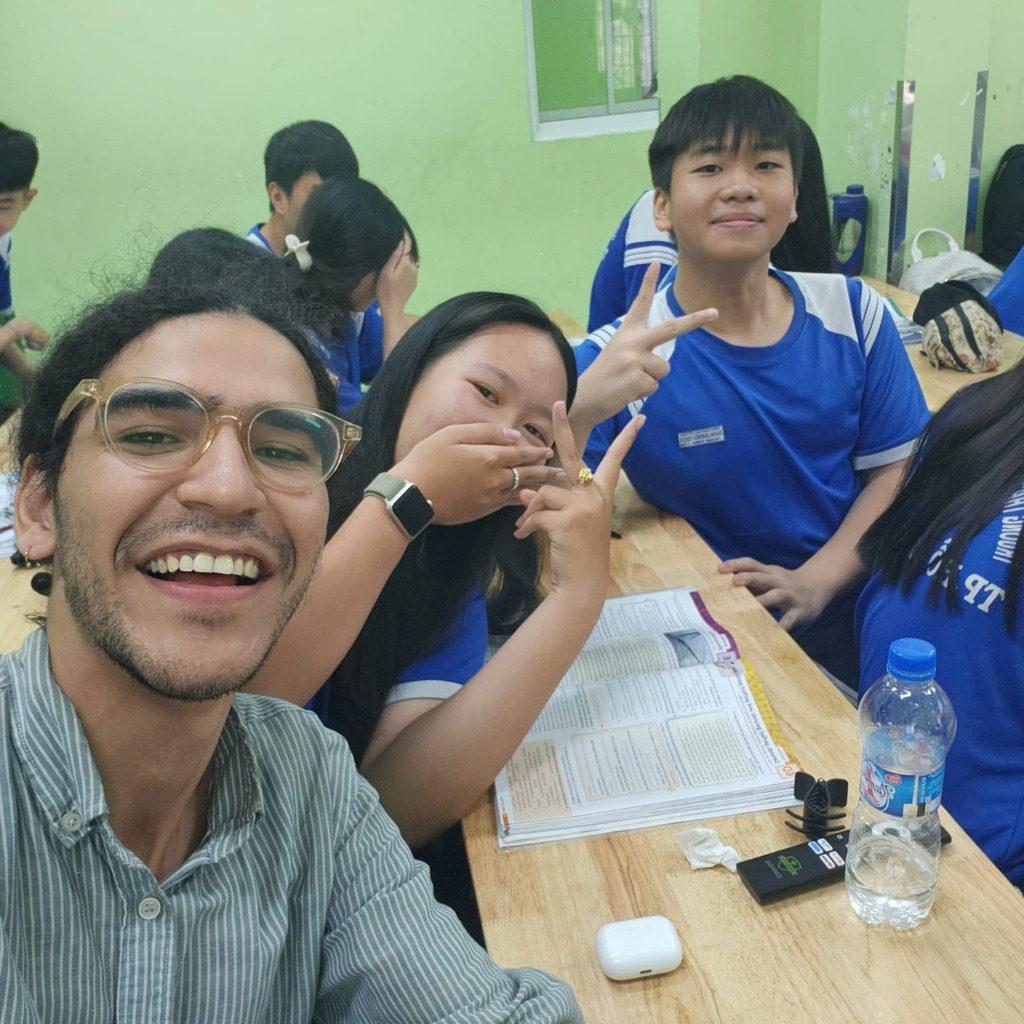
Isslem teaches at four schools in Thu Duc district. She rides between them on a 125cc Honda, lives in District 1, and clears $1,400 a month. When she described her schedule I expected her to complain about the commute. She didn't. Her exact words were that she liked having time to think between classes. She rides in the morning, teaches a block, grabs a coffee somewhere on the way to the next school, teaches another block, and usually finishes her day by 4pm. She said it beats being stuck in the same fluorescent staff room for nine hours straight.
I have time to think between classes. I like that part of it.
Language Centers and Kindergartens: Usually One Location
If you get hired directly by a private language center chain, you're typically assigned to one branch. You show up there, you teach your block, you go home. Same with kindergartens. These jobs are more settled. Less driving around, less calendar juggling, clearer expectations about what your Tuesday looks like.
The trade-off is the hours. Language centers schedule their teaching blocks around when kids and working adults can actually attend classes, which means 5pm to 9pm weeknights and most of Saturday and Sunday. You're working when the rest of Ho Chi Minh City is at dinner or out drinking. Some people love this — you get Monday and Tuesday as your weekend, you teach when you're naturally awake, you skip the commute rush entirely. Some people hate it and burn out within six months of evening shifts.
Olga, who teaches in Lang Son near the Chinese border, works at one language center. Her schedule is Tuesday through Friday from 4pm to 9pm plus weekend blocks. She spends about $400 a month on everything — rent, food, coffee, scooter petrol — and puts $600 or more into savings every month. She's been there two years and has no plans to add a second job. The way she described it, it was just "very convenient" — said the way someone says it about their favorite grocery store. She knows exactly where she'll be every workday. She hasn't had to memorize a new building's layout in 14 months.
The Single-School Dream (Real But Rare)
Teaching at one of the top-tier accredited international schools in Vietnam is the closest thing to a salaried Western job you'll find out here. Fixed hours, better pay, curriculum written by people who've heard of Oxford, mornings free. Hassan and Hussein, two brothers who came over from Lebanon, both landed this kind of role. When they told other teachers what their schedule looked like, nobody believed them at first. Monday to Friday, 7:30am to 3pm, no evenings, no weekends, no rotating between branches.
The catch: international schools want a real teaching license, usually two years of verified experience, and a degree in education or something adjacent. Most people reading this won't qualify right out of the gate. The brothers both did a year of grinding at a language center first and used that year to build the case for the international-school jump. It's a real path, just not a first-job path for most non-natives arriving with a TEFL and a bachelor's in something unrelated.
Why a Lot of Teachers Stack Two Jobs on Purpose
Here's where the multiple-schools thing stops being something that happens to you and starts being something you do on purpose. The base income at a single language center or public school gig runs about $1,200 a month for 20 hours a week. That's a fine number. You can live well on it in most Vietnamese cities. But if you want to save aggressively — send money home, stack a down payment, actually get ahead — you add a second contract.
The classic combo is a day job at a public school or kindergarten (roughly 8am to noon) and an evening job at a language center (5pm to 8pm). You teach 30 hours a week total. You make somewhere between $1,800 and $2,100. You still have one weekend day free, depending on how you set it up. More work, obviously, but it's not punishing — you're still doing less classroom time than a new teacher in the US or UK, for way more money after rent and food.
Selim, from Tunisia, runs exactly this setup. He teaches at a kindergarten in the morning and at a language center in the evening. Two schools, one Grab-bike ride between them, $2,100 a month, no degree in education. He said once he ran the math he didn't understand why anyone with energy and no kids at home would stick to just the one gig.
If you're already out here, you might as well cash in. Another three hours a day is another $700 a month. That adds up fast.
Mohamed runs a different version of the same idea. He teaches at two public schools — one middle school, one high school — in the same district, contracted through the same recruiting company. His Monday looks like seventh-graders in one building before lunch and eleventh-graders in another building after. Both contracts came bundled through the same agency, which handled the logistics end to end. He didn't hunt for a second job. The agency simply had demand at two schools and built his schedule that way from day one.
How This Actually Gets Decided
One thing nobody tells applicants until after they arrive: you don't pick your schools. The manager at your placement agency does, during the orientation week right after you land. They take your qualifications, your preferred district, your transport situation, the current demand across their client schools, and they build you a schedule. You see the result on day three or four, usually over a coffee meeting where they walk you through commute times and answer questions.
This sounds like a loss of control, and on paper it is. But it's also the only way the system works. You don't speak Vietnamese when you arrive. You don't know which school has a good vice-principal and which one is a nightmare. You don't know which neighborhoods are easy to ride through at 7am and which ones are gridlock by 7:05. The agency knows. Letting them assign the schedule saves you weeks of mistakes and gets you earning by the second week instead of the second month.
The Hidden Cost of Single-School Work
Working at one school sounds comfortable, and it often is, but it has costs people don't talk about. Your income ceiling is lower. Your professional network in the city stays smaller. Your exposure to different Vietnamese school management styles is limited, which matters if you ever want to move up the ladder out here or negotiate a better contract. Teachers who float between three or four schools tend to pick up contacts faster, figure out which kind of school actually fits them, and have a much easier time finding their next job when their current contract ends.
There's also a social angle nobody flags. Teachers at single-location gigs sometimes say they feel isolated — same coworkers every day, same building, same break room, same two or three people to get lunch with. Teachers on a multi-school rotation run into new foreign staff constantly. Isslem said her best friends in Vietnam all came from the different schools she bounced between in her first six months. She met them in the parking lot between classes, on the stairs, at the water cooler. That social pipeline doesn't exist when you're parked at one branch.

So What Should You Actually Aim For?
If you're coming out here for the first time and you don't have a teaching license, you're almost certainly going to start at either a language center (one location, evenings) or a public school cluster (three to five locations, mornings). Both are fine starting points. The center is easier on logistics but locks you into a night schedule. The public cluster is more fragmented but keeps your evenings and weekends free.
Six months in, reassess. A lot of people add a second contract at that point once they realize the first one isn't pushing their income hard enough. Some people go the other direction and drop to one contract because they've found the rhythm they want and decided the extra money isn't worth the extra teaching. Both are valid. Nobody looks at your schedule but you.
Frequently Asked Questions
Is it normal to work at multiple schools in Vietnam?+
Yes. For foreign teachers placed through recruiting companies, 3 to 5 schools per week is the standard setup. Single-location work is more typical for language centers and kindergartens, but public school placement almost always means a cluster.
How do teachers physically get between schools?+
Motorbike, almost always. Most Vietnamese cities are built around scooters and the roads work better on two wheels. Managers cluster your schools within about a 20-minute ride of each other, though that stretches to 30-35 minutes occasionally.
Can I ask for one school only?+
You can ask, but it's only likely if you get hired directly by a language center chain or kindergarten. Public school placements through agencies almost always involve multiple locations. The agency matches you to demand across their contracted schools, not the other way around.
How much more can I make by adding a second school?+
Roughly $600 to $900 extra per month for a typical second contract at a language center. A morning kindergarten or public school job at $1,200 plus an evening language center job brings most teachers to the $1,800-$2,100 range.
Who decides which schools I get?+
Your agency manager assigns the schools during orientation, usually day three or four after you arrive. They factor in your qualifications, your preferred district, your transport situation, and the current demand across their client schools. You don't apply to individual schools yourself.
Do I need to find the second job myself?+
Sometimes. If you want to stack a language center gig on top of a public school contract, you usually apply to the center directly once you've settled in. Some agencies place you at two linked schools (like Mohamed's case) where both come bundled, but that's less common.
Which setup has the best work-life balance?+
Single-location kindergartens or language centers with stable schedules win on predictability. Public school clusters win on free evenings and weekends. Dual contracts push income higher but cost you 6 to 10 extra hours of teaching per week. There's no universal best — it's a match between your energy level, your savings goals, and how much variety you want.
See What Your Vietnam Teaching Setup Would Actually Look Like
Take the quiz. Two minutes, honest questions about your qualifications, your timeline, and what you want out of this. We'll tell you which setup fits — one school, a public cluster, or a stacked schedule — and what you'd realistically earn.
No email required to start. Takes 2 minutes.